
Cómo elegir el material adecuado para un crisol: una guía completa
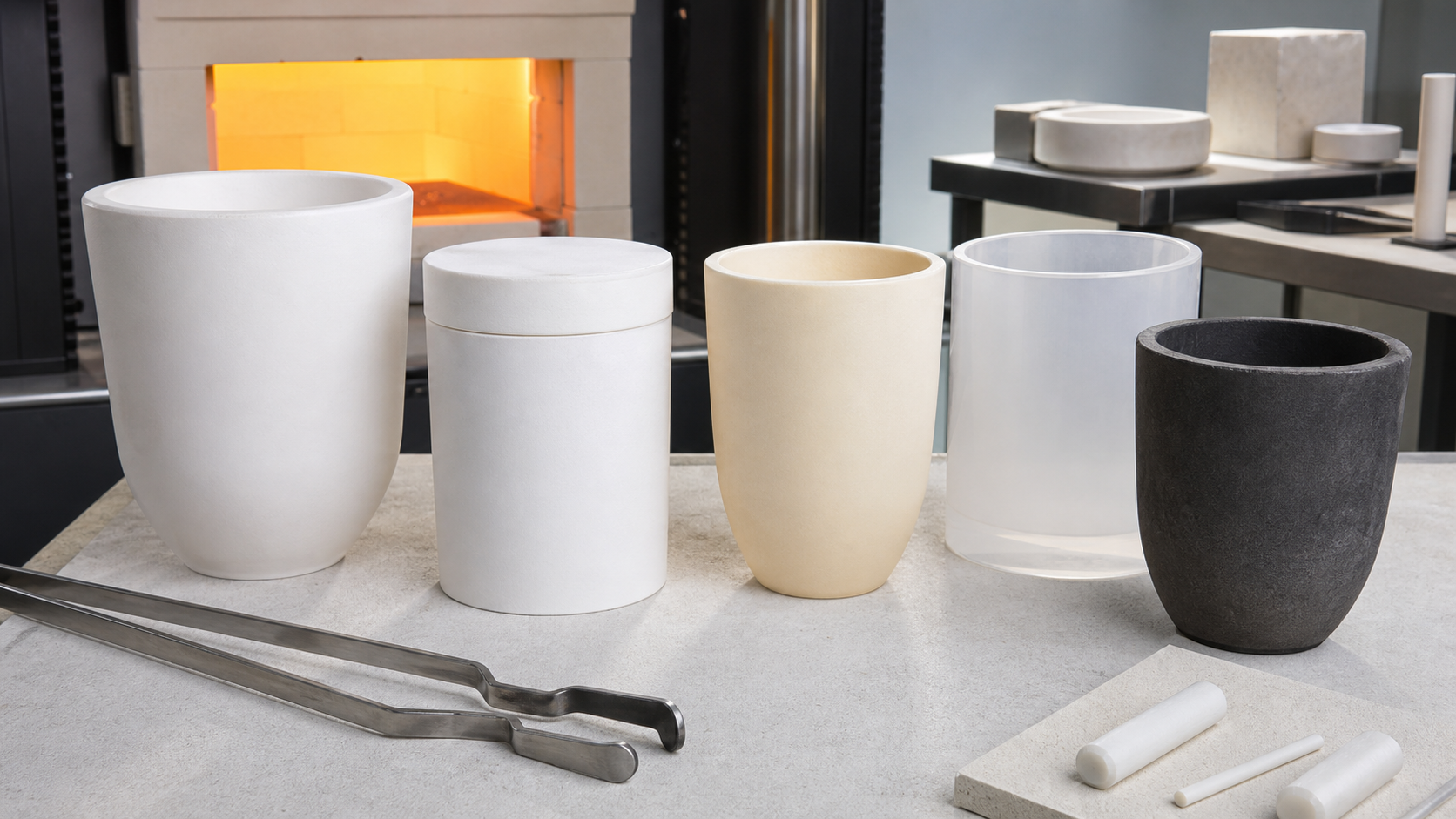
En resumen: La elección del material adecuado para el crisol depende de cinco factores: la temperatura máxima, la atmósfera del horno, la composición química de la masa fundida, los ciclos térmicos y la tolerancia a la contaminación. La alúmina es una opción básica fiable; el nitruro de boro es resistente al choque térmico y presenta un buen comportamiento de desmoldeo; el cuarzo es limpio para muchos procesos de laboratorio; la zirconia soporta temperaturas muy altas; y el grafito funciona mejor en vacío o en atmósferas inertes.
Elegir el material del crisol parece sencillo hasta que se produce la primera grieta en el recipiente, se contamina la masa fundida o falla un ciclo térmico. Un crisol no es solo un recipiente. Forma parte del sistema térmico, del sistema químico y del plan de control de la contaminación.
Para los investigadores y los ingenieros de procesos, elegir un crisol inadecuado puede alterar los resultados de los ensayos. Este puede reaccionar con la muestra, desprender partículas, deformarse con el calor o romperse durante el enfriamiento. Esta guía ofrece una forma práctica de comparar los materiales más habituales de los crisoles antes de encargar material de laboratorio o piezas cerámicas a medida.
El objetivo no es elegir un único ganador. El objetivo es reducir rápidamente las opciones y, a continuación, confirmar la calidad, la geometría y las condiciones del proceso mediante una revisión técnica.
¿Cuál es el mejor material para crisoles destinados a trabajos a alta temperatura?
El mejor material para crisoles es aquel que resiste conjuntamente la temperatura, la atmósfera y las condiciones químicas del proceso. La alúmina suele ser la primera opción para trabajos generales a alta temperatura. El nitruro de boro resulta útil por su resistencia al choque térmico y su comportamiento antihidrófilo. La circonia es adecuada para temperaturas muy elevadas. El grafito requiere un entorno de vacío o de gas inerte.
La temperatura por sí sola no es suficiente. Un crisol de grafito puede soportar calor extremo en condiciones inertes, pero no es una buena opción al aire a altas temperaturas, ya que la oxidación se convierte en un riesgo importante. El cuarzo es un material limpio y útil en muchos procesos de laboratorio, pero se ablanda a temperaturas muy inferiores a las de la zirconia.
Utilice la tabla que figura a continuación como herramienta de evaluación inicial, no como límite definitivo para el diseño. La calidad del proveedor, el espesor de la pared, la atmósfera del horno, la velocidad de calentamiento y la composición química de la muestra pueden alterar el rango de seguridad.
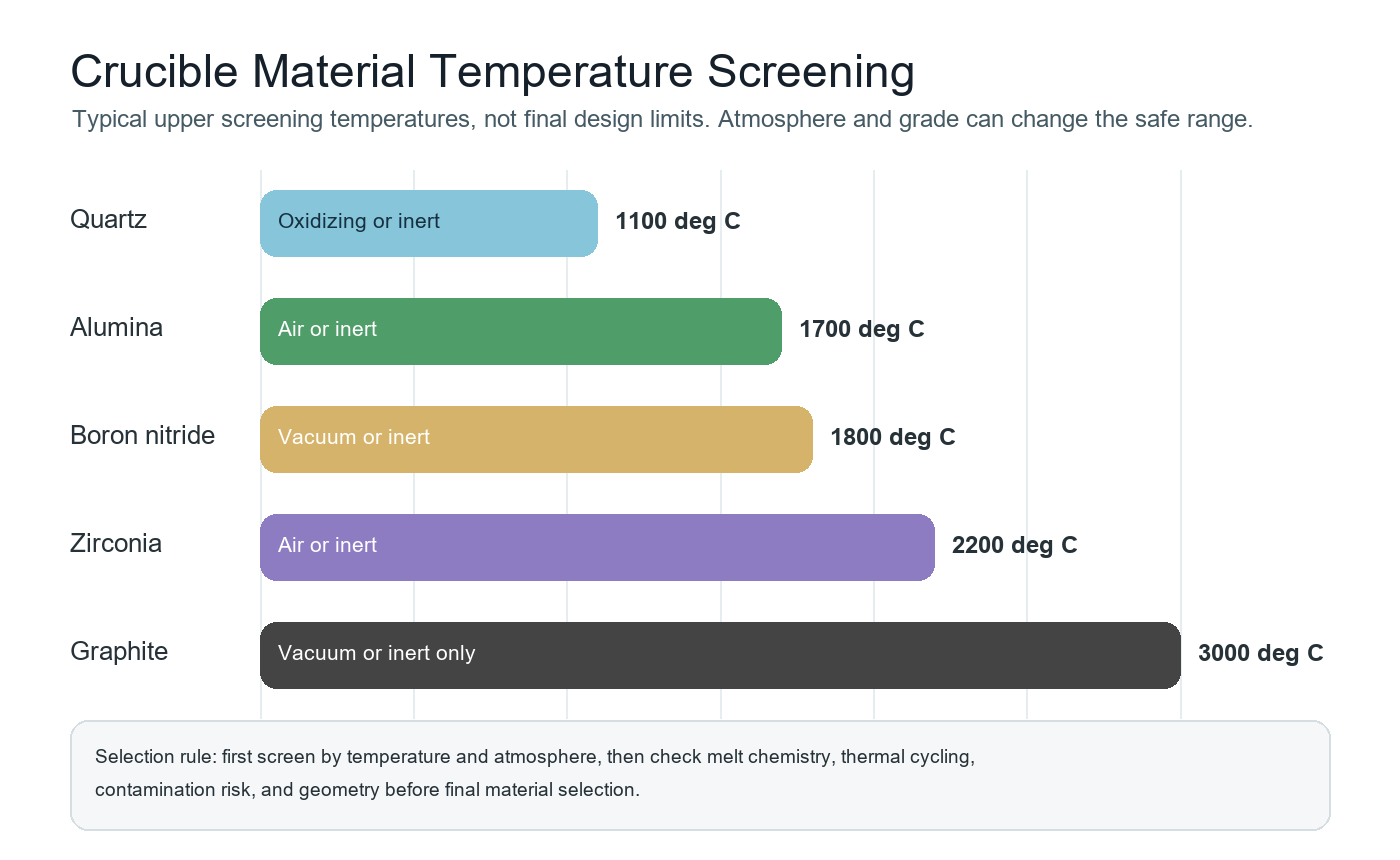
| Material del crisol | Temperatura habitual de cribado | El mejor ambiente | Ventaja principal | Punto de control |
|---|---|---|---|---|
| Cuarzo | 1 100 °C | Aire, vacío o gas inerte | Limpio, transparente, de baja expansión térmica | Ablandamiento y desvitrificación a altas temperaturas |
| Alúmina | 1 700 °C | Aire o gas inerte | Sólida base en cuanto a resistencia al calor y estabilidad química | El choque térmico depende de la geometría y de la velocidad de calentamiento |
| Nitruro de boro | 1 800 °C | Al vacío o en atmósfera inerte | Resistencia al choque térmico y comportamiento de desmoldeo | Límites de oxidación y resistencia mecánica |
| Zirconia | 2 200 °C | Aire o gas inerte | Resistencia a temperaturas muy elevadas | Análisis de costes y resistencia a los choques térmicos |
| Grafito | 3 000 °C | Al vacío o en atmósfera inerte | Calor extremo y buena conductividad térmica | Se oxida al contacto con el aire a altas temperaturas |
Estos valores de cribado coinciden con el comportamiento habitual del material descrito en la bibliografía para cerámica de alúmina, propiedades del grafito, y la guía actual de productos del Centro de Cerámica Avanzada para crisoles de nitruro de boro, crisoles de cerámica de circonio, y crisoles de cuarzo.
Empieza por la temperatura, pero no te quedes ahí
La temperatura es el primer filtro, ya que permite descartar rápidamente los materiales inadecuados. Si el ciclo del horno alcanza los 1 600 °C en aire, el cuarzo suele quedar descartado. Si el proceso alcanza los 2 000 °C, la zirconia puede entrar en consideración. Si el proceso supera los 2.500 °C, el grafito solo es una opción si se controla el oxígeno.
La siguiente pregunta es cómo varía la temperatura. Un calentamiento gradual es diferente a una introducción rápida en un horno caliente. El choque térmico se refiere a las grietas provocadas por un cambio rápido de temperatura. A menudo se recurre a materiales como el nitruro de boro cuando las velocidades de calentamiento y enfriamiento son problemáticas.
La geometría también es importante. Un crisol de paredes finas puede reaccionar ante los cambios de temperatura de forma diferente a una pieza a medida de paredes gruesas. Las esquinas, las tapas, los orificios, las ranuras y los cambios bruscos de diámetro pueden provocar concentraciones de tensión. En el caso de trabajos a medida, envíenos el plano y el perfil de rampa lo antes posible.
¿Cómo influye la atmósfera del horno en la elección del crisol?
La atmósfera del horno puede convertir un buen material en uno de mala calidad. El aire, el vacío, el nitrógeno, el argón, el hidrógeno y las atmósferas reductoras influyen en la oxidación, la contaminación y la estabilidad química. El grafito resulta útil en vacío o en presencia de un gas inerte, pero la oxidación limita su uso en el aire. El BN también requiere una revisión de la atmósfera.
Las condiciones ambientales son la razón por la que una simple clasificación por temperatura puede resultar engañosa. El grafito puede parecer la mejor opción en una tabla de altas temperaturas, pero la exposición al oxígeno puede hacer que no sea adecuado. La alúmina puede tener una temperatura máxima inferior a la del grafito, pero puede resultar más práctica en condiciones oxidantes.
El nitruro de boro suele ser una opción interesante en entornos de vacío o en atmósferas inertes, ya que es mecanizable, resiste los choques térmicos y presenta propiedades de desmoldeo frente a muchos materiales fundidos. Para accesorios de hornos, boquillas, placas de colada y crisoles, crisoles de nitruro de boro merece la pena revisarlas cuando el problema principal es la adherencia o los ciclos térmicos.
El cuarzo funciona bien en muchos entornos de laboratorio limpios, especialmente cuando es importante la inspección visual o se busca un bajo nivel de contaminación. Sin embargo, a temperaturas más altas, el cuarzo puede ablandarse o cambiar de estructura, por lo que debe adaptarse al ciclo térmico concreto.
Adapta el crisol a la composición química del fundido o de la muestra
La compatibilidad química determina si el crisol permanece inerte o pasa a formar parte de la reacción. Algunas fundiciones atacan a los óxidos. Algunas muestras absorben carbono. Algunos procesos no toleran la contaminación por boro, silicio, aluminio o circonio.
En el caso de las muestras de óxido, la alúmina suele ser un punto de partida práctico. Se utiliza ampliamente porque ofrece una gran dureza, aislamiento eléctrico y estabilidad química. Además, se combina bien con otros componentes de alúmina, como tubos de alúmina, placas de alúmina, y piezas de alúmina a medida.
En el caso de metales fundidos o procesos en los que existe riesgo de adherencia, el nitruro de boro puede resultar útil, ya que su superficie reduce la humectabilidad. Para el procesamiento de óxidos a temperaturas muy elevadas, la circonia puede ser más resistente que el cuarzo o la alúmina, pero es necesario comprobar la composición química de la muestra. En trabajos en los que el carbono es un factor sensible, es posible que el grafito no sea adecuado, incluso si se controla la atmósfera.
La solicitud de presupuesto más precisa incluye el tipo de muestra o la familia de materiales fundidos, la temperatura del proceso, la atmósfera, el tiempo de mantenimiento, la velocidad de calentamiento y los elementos contaminantes permitidos. Esa información permite al proveedor identificar los modos de fallo reales, en lugar de tener que hacer conjeturas basándose únicamente en el nombre del material.
Alúmina frente a nitruro de boro frente a circonio frente a cuarzo frente a grafito
Cada material de crisol tiene unas características de resistencia diferentes. La alúmina es la opción más equilibrada. El nitruro de boro es la opción ideal para resistir los choques térmicos y facilitar el desmoldeo. La circonia es adecuada para temperaturas muy elevadas. El cuarzo resulta útil para trabajos de laboratorio que requieren un entorno limpio. El grafito es adecuado para temperaturas extremas en condiciones sin oxígeno.
| Material | Elígelo cuando | Evítalo o revísalo con atención cuando |
|---|---|---|
| Alúmina | Necesitas una cerámica de alta temperatura y buena relación calidad-precio para aplicaciones con aire o gases inertes | El proceso presenta un choque térmico grave o una composición química de la masa fundida inusual |
| Nitruro de boro | Necesitas resistencia al choque térmico, mecanizabilidad o propiedades hidrofóbicas | El horno se está oxidando a alta temperatura o la pieza soporta una carga elevada |
| Zirconia | Necesitas una resistencia a temperaturas muy altas y estabilidad química | El coste, los ciclos térmicos o el tamaño de las piezas son las principales limitaciones |
| Cuarzo | Necesitas un crisol limpio para realizar trabajos de laboratorio a temperaturas moderadamente altas | El ciclo se acerca a unas condiciones más suaves o implica el uso de productos químicos agresivos |
| Grafito | Se necesita un calor extremo en vacío o en atmósfera inerte | La presencia de oxígeno o la contaminación por carbono es inaceptable |
Esta comparación también resulta útil a la hora de elegir los componentes del horno. Un crisol rara vez funciona por sí solo. Las barquillas, los tubos, las placas, los soportes de fijación, las tapas y los soportes deben seleccionarse como un sistema integrado. Si el proceso también requiere accesorios, consulte las páginas de productos cerámicos actuales, como crisoles de nitruro de aluminio o crisoles de nitruro de silicio, cuando la conductividad térmica, la resistencia o unas condiciones de proceso especiales son factores determinantes.
¿Qué datos deben facilitar los compradores antes de encargar un crisol a medida?
Debe proporcionar el plano, las dimensiones, las tolerancias, la cantidad, el material deseado, la temperatura máxima, la atmósfera, la velocidad de calentamiento, el tiempo de mantenimiento, la composición química de la muestra y los límites de contaminación. Si el material aún no es definitivo, envía la solicitud en lugar de limitarte a pedir un presupuesto para un solo tipo de material.
Una buena solicitud técnica suele incluir:
- Diámetro exterior, diámetro interior, altura, espesor de la pared y espesor del fondo.
- Tapa, reborde, pico vertedor, orificios, ranuras u otros detalles geométricos.
- Temperatura máxima y temperatura normal de funcionamiento.
- Atmósfera del horno, como aire, vacío, argón, nitrógeno o gas reductor.
- Velocidad de calentamiento y enfriamiento si existe riesgo de choque térmico.
- Química de fusión, de polvos, de muestras o de reacciones.
- Requisitos de pureza y elementos que deben evitarse.
- Cantidad de prototipos y cantidad prevista de producción.
En el caso de las formas personalizadas, también resulta útil indicar si el crisol se utiliza para fundición, calcinación, evaporación, sinterización, crecimiento de cristales o análisis. El proceso de fabricación puede variar cuando el mismo material debe convertirse en un pequeño crisol de laboratorio, un recipiente de gran tamaño o una pieza mecanizada de precisión.
Errores habituales en la selección
El error más común es basar la elección únicamente en la temperatura máxima. El segundo es no tener en cuenta el entorno. El tercero es dar por sentado que el nombre de un material siempre se refiere al mismo grado. La alúmina, el nitruro de boro, la circonia, el cuarzo y el grafito pueden variar en cuanto a pureza, densidad, aditivos y método de fabricación.
Otro error es considerar el choque térmico como una propiedad única del material. El choque térmico depende del material, la forma, el espesor de la pared, la diferencia de temperatura y la velocidad de transferencia de calor. Un crisol pequeño y uno grande fabricados con el mismo material pueden comportarse de forma diferente.
Además, la contaminación pasa fácilmente desapercibida. Un crisol puede superar la prueba y, aun así, no ser adecuado si introduce oligoelementos en la muestra. Los usuarios del ámbito de la investigación deben establecer desde el principio los límites de impurezas, especialmente en trabajos analíticos, procesos relacionados con semiconductores, materiales para baterías y el desarrollo de polvos de alta pureza.
Lista de comprobación final antes de decidirte
Antes de la selección final, comprueba el proceso en este orden:
- Temperatura: máxima, normal y tiempo de mantenimiento.
- Atmósfera: aire, vacío, gas inerte, gas reductor o condiciones variables.
- Química: fundido, polvo, vapor, fundente, método de limpieza y productos de reacción.
- Ciclo térmico: velocidad de calentamiento, velocidad de enfriamiento, riesgo de temple y método de carga.
- Contaminación: elementos permitidos y prohibidos.
- Geometría: dimensiones, espesor de pared, tapa, orificios, esquinas y requisitos de mecanizado.
- Adquisiciones: cantidad, plazo de entrega, inspección, embalaje y documentación.
Si, tras revisar esta lista de comprobación, sigue pareciendo que dos materiales son compatibles, realiza una pequeña prueba de proceso antes de pasar a una escala mayor. Los crisoles son económicos en comparación con el tiempo de horno perdido, las muestras dañadas o los resultados de ensayo poco claros.
Si necesitas ayuda técnica, comparte tus condiciones de diseño y funcionamiento con Centro de cerámica avanzada. Un análisis técnico puede ayudar a comparar la alúmina, el nitruro de boro, la circonita, el cuarzo, el grafito y otras opciones de cerámica avanzada antes de la producción.
Preguntas frecuentes
¿Qué material es el más adecuado para un crisol a 1600 °C en aire?
La alúmina suele ser un punto de partida práctico para trabajos a 1.600 °C en aire, ya que es químicamente estable, fácil de conseguir y rentable. Se puede considerar el uso de circonio cuando la temperatura es más alta o cuando la composición química lo requiere. La elección final sigue dependiendo de la composición química de la muestra y de los ciclos térmicos.
¿Es el nitruro de boro mejor que la alúmina para los crisoles?
El nitruro de boro no es simplemente mejor que la alúmina. Es mejor cuando son importantes el choque térmico, la maquinabilidad o el comportamiento antihidrófilo. La alúmina suele ser mejor cuando el proyecto requiere una cerámica de alta temperatura resistente, económica y de uso general.
¿Se pueden utilizar crisoles de grafito al aire libre?
El grafito debe analizarse cuidadosamente en contacto con el aire, ya que la oxidación se convierte en un problema grave a altas temperaturas. Por lo general, se elige para entornos de vacío o atmósferas inertes, donde resultan útiles su resistencia al calor extremo y su conductividad térmica.
¿Qué material es el más adecuado para los crisol en un laboratorio?
El cuarzo y la alúmina de alta pureza son materiales de partida habituales para el trabajo de laboratorio en condiciones de limpieza. El cuarzo resulta útil cuando la visibilidad y la limpieza son importantes a temperaturas moderadamente altas. La alúmina es más adecuada cuando la temperatura es más elevada o cuando el proceso requiere un cuerpo cerámico más resistente.
¿Necesito un crisol a medida o uno estándar?
Utilice un crisol estándar cuando el tamaño, la pureza y el rango de temperatura ya se ajusten al proceso. Opte por un crisol a medida cuando el horno, el volumen de la muestra, el diseño de la tapa, la geometría, la tolerancia o los requisitos de control de la contaminación no puedan satisfacerse con una forma estándar.