


Macor Machinable Glass Ceramic: Key Applications in Electronics (2026 Guide)
Overview
Macor machinable glass ceramic, developed by Corning, is a remarkable hybrid material that combines the versatility of glass with the durability of ceramics, making it a cornerstone in advanced engineering applications. Unlike traditional ceramics, which often require specialized tools for shaping, Macor can be machined with standard metalworking equipment, offering unparalleled flexibility for precision components. Its unique combination of electrical insulation, thermal stability, and machinability has positioned it as a critical material in the electronics industry, where high-performance materials are essential for cutting-edge technologies.
In the rapidly evolving electronics sector, materials like Macor are vital for meeting the demands of miniaturization, high-frequency performance, and reliability in harsh environments. As we approach 2025, the proliferation of 5G networks, Internet of Things (IoT) devices, and advanced semiconductor manufacturing underscores the growing importance of Macor. This guide aims to provide a comprehensive exploration of Macor’s properties, specifications, and key applications in electronics, offering insights into why it remains a preferred choice for engineers and manufacturers.
Unter China Ceramic Manufacturer, Wir sind spezialisiert auf hochwertige advanced keramische Erzeugnisse with various materials and specifications, ensuring optimal performance for industrial and scientific applications.
What is Macor Machinable Glass Ceramic?
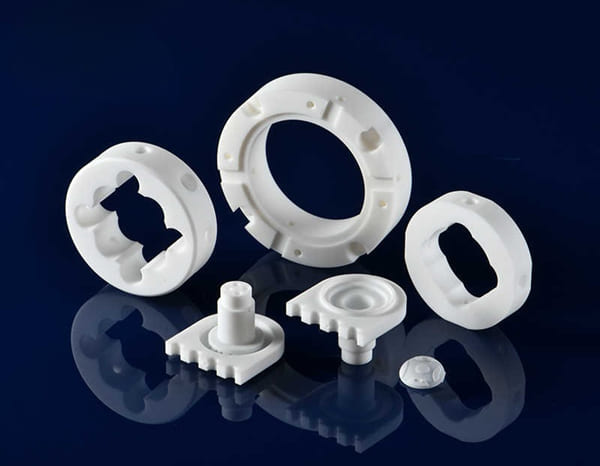
Macor is a machinable glass ceramic by Corning, combining the workability of glass with the strength of ceramics. Made of 55% fluorophlogopite mica in a borosilicate glass matrix, it offers both mechanical versatility and thermal stability. Unlike traditional ceramics, Macor can be machined into complex shapes with standard tools, avoiding the need for diamond tooling or laser cutting.
Macor’s machinability allows rapid prototyping and cost-effective precision production. It can be drilled, turned, or milled without fracturing, making it ideal for tight-tolerance applications. Additionally, Macor offers excellent electrical insulation and low thermal conductivity, crucial for electronics exposed to high voltages or temperature gradients.
Macor was developed to combine easy fabrication with high performance. Its stability under thermal and electrical stress makes it ideal for industries like aerospace and medical devices, particularly in electronics for its dielectric properties and high-frequency circuit compatibility.
Unique Features:
- Machinable with standard metalworking tools (e.g., carbide drills, lathes).
- Composed of fluorophlogopite mica in a borosilicate glass matrix.
- Offers electrical insulation and thermal stability up to 1000°C (no load).
- Suitable for rapid prototyping and small-batch production.
1. Composition & Structure of Macor
| Komponente | Phase | Role | Percentage |
| Boron oxide (B₂O₃) + Silica (SiO₂) | Glass (amorphous) | Enables machinability with metal tools | 55% |
| Fluorophlogopite mica (Mg₃Si₄O₁₀F₂) | Crystalline | Provides mechanical strength | 45% |
| Key Structural Note: Homogeneous mix of glass (for workability) and mica crystals (for stability). | |||
2. Macor vs. Other Ceramics (Comparison)
| Eigentum | Macor® | Tonerde (Al₂O₃) | Aluminiumnitrid (AlN) | Zirkoniumdioxid (ZrO₂) |
| Bearbeitbarkeit | ★★★★★ (Metal tools) | ★☆☆☆☆ (Diamond tools) | ★☆☆☆☆ | ★★☆☆☆ (Grinding) |
| Wärmeleitfähigkeit | 1.46 W/m·K (Low) | 30 W/m·K (Medium) | 180 W/m·K (High) | 2–3 W/m·K (Low) |
| Max Use Temperature | 800°C (short: 1000°C) | 1600°C | 1300°C | 1500°C |
| Biegefestigkeit | ~15,000 psi | ~50,000 psi | ~40,000 psi | ~65,000 psi |
| Cost (Machining) | Niedrig | Hoch | Sehr hoch | Hoch |
| Am besten für | Complex prototypes, insulators | High-wear parts | Heat sinks, high-power electronics | Structural components |
Suche nach top-quality advanced ceramic products? Explore China Ceramic Manufacturer’s selection.
What Are The Key Properties of Macor?
Macor’s low density of 2.52 g/cm³ makes it lightweight, while its 250 Knoop hardness ensures durability and machinability for intricate shapes. Its ability to achieve tight tolerances (±0.013 mm) makes it ideal for precision electronics, balancing reliability and performance.
Macor has low thermal conductivity (1.46 W/m·K) to minimize heat transfer in electronics. It withstands continuous temperatures up to 800°C and intermittent exposure to 1000°C, making it ideal for high-temperature environments. Its low coefficient of thermal expansion (9.3 x 10⁻⁶/K) ensures stability and reduces the risk of cracking.
Macor’s high dielectric strength (40 kV/mm) effectively insulates high-voltage circuits. Its low dielectric loss (tan δ ≈ 0.002 at 1 MHz) and stable dielectric constant (≈5.9) make it ideal for high-frequency applications. Its resistance to acids, alkalis, and corrosion ensures durability in harsh environments like chemical vapor deposition systems.
1. Grundlegende Eigenschaften
| Eigentum | Wert | Bedeutung |
| Dichte | 2,52 g/cm³ | Lightweight for a ceramic |
| Farbe | Bright white | Aesthetic & non-contaminating |
| Oberfläche | Ra ≤0.8 µm (polished) | Smooth for precision applications |
2. Mechanische Eigenschaften
| Eigentum | Wert | Comparison |
| Biegefestigkeit | 15,000 psi (103 MPa) | Lower than alumina but sufficient for non-load-bearing parts |
| Druckfestigkeit | 50,000 psi (345 MPa) | Resists crushing forces well |
| Härte (Mohs) | 5.5 | Softer than most ceramics (e.g., alumina ~9) |
| Elastischer Modul | 66 GPa | Stiffer than polymers, less brittle than other ceramics |
3. Thermische Eigenschaften
| Eigentum | Wert | Vorteil |
| Maximale Betriebstemperatur | Stable in high-temperature environments | Stable in high-temp environments |
| Wärmeleitfähigkeit | 1.46 W/m·K | Ausgezeichneter Isolator |
| CTE (20–300°C) | 9.3 × 10⁻⁶/°C | Matches many metals (e.g., steel) for bonding |
| Widerstandsfähigkeit gegen thermische Schocks | High (due to low CTE + machinability) | Survives rapid temp changes |
4. Electrical & Chemical Properties
| Eigentum | Wert | Anwendungen |
| Dielektrische Festigkeit | ≥40 kV/mm | High-voltage insulators |
| Volumenwiderstand | >10¹⁴ Ω·cm at 25°C | Non-conductive |
| Chemische Beständigkeit | Resists acids/alkalis (except HF) | Corrosion-resistant housings |
| Vacuum Compatibility | Outgassing <10⁻⁹ Torr | UHV systems |
Unique Functional Advantages
- Bearbeitbarkeit: The only ceramic drillable/tappable with standard tools.
- Präzision: Holds ±0.01 mm tolerances for complex geometries.
- RF Transparency: Ideal for microwave/antenna components.
- Nichtmagnetisch: Critical for MRI and sensitive instrumentation.
Exploring our optimized advanced ceramic products.
What Are The Key Applications of Macor in Electronics?
Macor’s unique properties make it essential in electronics, especially with advancing technology. It is widely used in high-voltage and high-frequency circuits, including power electronics and telecommunications, providing reliable insulation in applications like capacitor supports and circuit board standoffs.
In semiconductor manufacturing, Macor is used for fixtures and precision components in CVD and plasma etching systems. Its machinability and chemical resistance ensure dimensional stability under thermal and chemical stress, making it ideal for advanced microchip production in AI and 5G applications.
By 2025, Macor’s applications are growing with trends like miniaturized electronics for wearables and IoT, where its compact, high-performance components are key. Its thermal stability benefits aerospace electronics, while its role in RF components is crucial for the rise of 5G technology and next-gen connectivity.
1. High-Temperature Insulators
Macor® is widely used in resistors and capacitors where high-temperature stability and electrical insulation are critical. Its ability to withstand up to 800°C without degradation makes it ideal for power electronics and industrial heating systems.
| Eigentum | Macor Advantage |
| Maximale Betriebstemperatur | 800°C (short-term 1000°C) |
| Dielektrische Festigkeit | ≥40 kV/mm (excellent insulation) |
| Widerstandsfähigkeit gegen thermische Schocks | Low CTE prevents cracking |
| Example Use Case | High-power resistor mounts in aerospace |
2. Halbleiter-Komponenten
Macor provides non-contaminating, precision-machined housings for semiconductor devices, ensuring stability in cleanroom environments and high-vacuum conditions.
| Eigentum | Macor Advantage |
| Vacuum Compatibility | Outgassing <10⁻⁹ Torr |
| Dimensional Stability | ±0.01 mm tolerance |
| Chemische Beständigkeit | Resists plasma/etchants |
| Example Use Case | Wafer chucks in semiconductor fabrication |
3. Circuit Boards and Connectors
Macor® is used in PCB designs for high-frequency applications, offering RF transparency and minimal signal loss.
| Eigentum | Macor Advantage |
| Dielektrischer Verlust (tan δ) | <0.001 at 1 MHz |
| RF Transparency | Ideal for microwave circuits |
| Bearbeitbarkeit | Custom shapes without diamond tools |
| Example Use Case | High-frequency connector bases |
4. Elektronische Verpackungen
Macor® protects high-power electronics (e.g., IGBT modules) with its thermal stability and electrical isolation.
| Eigentum | Macor Advantage |
| Wärmeleitfähigkeit | 1.46 W/m·K (insulating) |
| EMI Shielding | Non-conductive, no interference |
| Leichtgewicht | 2.52 g/cm³ (vs. metals) |
| Example Use Case | High-voltage power module enclosures |
5. Wärmesenken
While Macor® has low thermal conductivity, it is used in niche cooling systems where electrical insulation is prioritized over heat dissipation.
| Eigentum | Macor Advantage |
| Wärmeleitfähigkeit | 1.46 W/m·K (better than plastics) |
| Electrical Isolation | >10¹⁴ Ω·cm resistivity |
| Temperaturbeständigkeit | Stable up to 800°C |
| Example Use Case | Insulating spacers in laser diode coolers |
Request a custom quote for high-quality advanced ceramic products.
What Are The Advantages of Using Macor in Electronics?
Macor stands out in electronics due to its ease of machining, excellent electrical insulation (40 kV/mm dielectric strength), and thermal stability (withstanding up to 800°C), making it ideal for high-voltage and high-temperature applications like semiconductor processing and aerospace electronics. However, its mechanical strength (≈345 MPa) is lower than ceramics like alumina, limiting its use in high-stress environments. Additionally, its cost is higher than simpler insulators, and its brittleness requires careful handling. To address these challenges, engineers can reinforce Macor with metal supports or combine it with stronger ceramics for stress points, while optimizing costs by minimizing waste and targeting high-value applications.
1. Superior Machinability
Unlike traditional ceramics (e.g., alumina, AlN), Macor can be precision-machined using standard metalworking tools, reducing production time and cost.
| Merkmal | Macor | Tonerde (Al₂O₃) | Plastics (e.g., PEEK) |
| Machining Method | CNC, drilling, tapping | Diamond grinding only | CNC (but soft/wears) |
| Tolerance Precision | ±0.01 mm | ±0.05 mm | ±0.1 mm |
| Post-Machining | None needed | Polishing required | Deformation risk |
2. Exceptional Electrical Insulation
Macor®’s ultra-high resistivity and dielectric strength prevent leakage currents and arcing, even in high-voltage environments.
| Eigentum | Macor | Tonerde | AlN |
| Dielektrische Festigkeit | ≥40 kV/mm | 15–20 kV/mm | 15–20 kV/mm |
| Volumenwiderstand | >10¹⁴ Ω-cm | >10¹⁴ Ω-cm | >10¹⁴ Ω-cm |
| Dielektrischer Verlust (tan δ) | <0,001 | 0.0001–0.001 | 0.0005–0.002 |
3. Thermal Stability & Low CTE
Macor® maintains dimensional stability across extreme temperatures and thermal cycles, critical for bonded assemblies.
| Eigentum | Macor | Rostfreier Stahl | Plastics |
| Maximale Betriebstemperatur | 800°C | 500–800°C | 150–300°C |
| CTE (20–300°C) | 9.3 × 10⁻⁶/°C | 17 × 10⁻⁶/°C | 50–100 × 10⁻⁶/°C |
| Widerstandsfähigkeit gegen thermische Schocks | Hoch | Mäßig | Schlecht |
4. Vacuum & Chemical Compatibility
Macor® outperforms metals and plastics in ultra-high vacuum (UHV) and corrosive environments.
| Eigentum | Macor | Metalle | PTFE |
| Outgassing Rate | <10⁻⁹ Torr | Moderate (oxides) | High (hydrocarbons) |
| Chemische Beständigkeit | Resists acids/alkalis (except HF) | Corrodes | Limited solvent resistance |
| Nichtmagnetisch | Ja | No (Fe/Ni alloys) | Ja |
5. RF Transparency & EMI Shielding
Macor®’s low dielectric loss makes it ideal for high-frequency applications where signal integrity is critical.
| Eigentum | Macor | FR4 PCB | Metalle |
| Dielektrizitätskonstante (1 MHz) | 6.1 | 4.3–4.8 | N/A (conductive) |
| EMI Shielding | Non-conductive | Keine | Yes (but interferes) |
| Gewicht | Light (2.52 g/cm³) | 1.8 g/cm³ | Heavy (7.8+ g/cm³) |
6. Cost & Lead Time Efficiency
Macor® reduces costs by eliminating diamond tooling and enabling rapid prototyping.
| Factor | Macor | Tonerde | Machined Metal |
| Tooling Cost | Niedrig (standard tools) | High (diamond) | Mäßig |
| Lead Time (complex parts) | 1–2 weeks | 3–6 weeks | 2–4 weeks |
| Scalability | Hoch (batch machining) | Niedrig | Mäßig |
When to Choose Macor?
✅ Need machinability + insulation? Macor® beats alumina and plastics.
✅ Operating in vacuum/radiation? Outperforms metals and polymers.
✅ High-frequency/RF designs? Superior to FR4 and metals.
Unter China Ceramic Manufacturer, liefern wir keramische Produkte in optimierter Qualität, die den folgenden Anforderungen entsprechen ASTM und ISO Standards, die sicherstellen hervorragende Qualität und Zuverlässigkeit.
Future Trends and Developments in Macor for Elektronik
As the electronics industry evolves toward 2025, Macor is set to play a key role in emerging technologies. Its low dielectric loss and machinability make it ideal for high-performance insulators and RF components in 5G networks and IoT devices. Macor’s precision and chemical stability also make it perfect for advanced semiconductor fabrication supporting AI, quantum computing, and high-performance chips. With the trend toward smaller chips, Macor’s thermal and electrical properties meet the demands of extreme processing conditions. Additionally, its potential for eco-friendly manufacturing and recycling aligns with the industry’s sustainability goals. Macor’s reliability in aerospace electronics, particularly in satellite communication systems, will also expand as space exploration advances.
- Increased demand for 5G and IoT insulators and RF components.
- Critical role in semiconductor equipment for AI/quantum computing.
- Advances in eco-friendly manufacturing and recycling.
- Expanded use in aerospace and space electronics.
Macor machinable glass ceramic stands as a testament to material innovation, offering a unique blend of machinability, electrical insulation, and thermal stability that is critical for the electronics industry. Its ability to be shaped with standard tools while maintaining high-performance characteristics makes it a versatile choice for applications ranging from high-voltage insulators to RF components. As electronics technology advances toward 2025, Macor’s role in enabling 5G, IoT, and advanced semiconductor manufacturing underscores its enduring relevance.
Selecting Macor for specific electronic applications requires balancing its advantages, such as ease of fabrication and dielectric performance, with its limitations, like moderate mechanical strength. By leveraging design optimization and proper handling techniques, engineers can maximize Macor’s potential. Looking ahead, Macor’s adaptability to emerging trends, including sustainable manufacturing and aerospace applications, ensures it will remain a vital material in shaping the future of electronics.
Für top-quality advanced ceramic materials, China Ceramic Manufacturer bietet maßgeschneiderte Lösungen für verschiedene Anwendungen.
Looking for premium ceramic materials? Kontaktieren Sie uns noch heute!