
 French
  English
  German
  Spanish
 Densifying Alumina: Strategies for Porosity Reduction and Enhanced Densification
Céramiques d'alumine, known for their excellent high-temperature stability, good mechanical strength, and outstanding electrical insulation properties, are widely used in fields such as electronics, metallurgy, chemical engineering, and aerospace. However, their final performance largely depends on the material’s microstructure, particularly porosity and bulk density. Pores, acting as stress concentration points, significantly degrade the material’s fracture toughness, bending strength, and wear resistance. Additionally, the presence of open pores can severely affect its dielectric strength and corrosion resistance. Therefore, minimizing porosity and enhancing bulk density are key to optimizing the performance of alumina ceramics. Achieving this goal requires precise control over three critical processes: raw powder materials, forming techniques, and sintering processes.
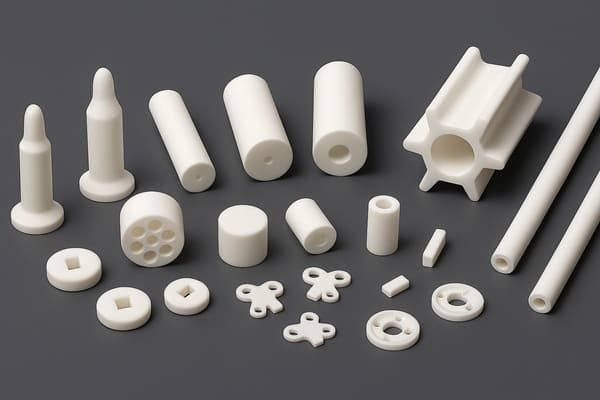
Au Pôle Céramique avancéeNous sommes spécialisés dans les produits de haute qualité céramique d'alumine produits avec une variété de formes et de spécifications, garantissant des performances optimales pour les applications industrielles et scientifiques.
Why Density Matters?
Alumina ceramics are fundamental materials in modern industry, but their performance ceiling is often determined by stubborn internal porosity. These microscopic voids act as “hidden flaws” within the material, becoming stress concentration points under mechanical load, scattering sources in thermal pathways, and breakdown channels in electric fields.
The Foundation of Performance: High density is the essential prerequisite for alumina to achieve its high hardness, strength, wear resistance, superior insulation, and good light transmission.
The Problem with Pores: Residual pores, especially those at grain boundaries:
- Significantly Reduce Mechanical Strength: Acting as crack initiation points.
- Degrade Thermal Performance: Scattering phonons and hindering heat conduction.
- Impair Electrical Properties: Reducing dielectric strength and insulating capability.
Core Factors Governing Densification
1. Raw Material Powder: The Starting Point
A powder consisting of uniform, well-dispersed spherical particles resembles a box of neatly packed marbles under the microscope. This high and uniform packing density provides the perfect starting point for densification. Conversely, a powder full of hard agglomerates and irregular sizes contains inherent flaws in its green body, like an unstable foundation, making it difficult to repair during sintering.
Powder characteristics determine the “upper limit” of sintering. The ideal starting powder should have:
- Fine Particle Size: A Higher specific surface area provides a greater sintering driving force.
- Narrow Particle Size Distribution: Ensures uniform particle packing, minimizing large voids.
- No Hard Agglomerates: Agglomerates cause non-uniform shrinkage and macro-defects.
- High Phase Purity and Sinterability: Primarily the stable alpha phase, yet with high surface energy for easy sintering.
The characteristics of raw powder materials serve as the foundation for determining the final sintered body density. The primary prerequisite for achieving high densification is the selection of high-purity, high-sintering-activity ultra-fine alumina powder.
Powder Particle Size and Distribution: Using sub-micron or even nano-sized alumina powders can significantly increase the driving force for sintering and reduce the densification temperature. Moreover, by optimizing the particle size distribution, fine particles can fill the gaps between coarser particles, effectively improving the initial packing density of the green body, thus laying a solid foundation for subsequent sintering densification.
Choice of Additives: Introducing appropriate sintering additives (such as MnO₂, TiO₂, MgO, etc.) is key to promoting densification. Taking MgO as an example, it can prevent abnormal grain growth by inhibiting grain boundary migration, thereby facilitating the full elimination of pores during normal grain growth, ultimately resulting in a fine, uniform microstructure with dense and compact grains.
2. Optimization and Innovation of Molding Processes
The goal of the molding process is to shape powder particles into green bodies with high uniformity and initial density, reducing subsequent sintering difficulties caused by molding defects.
Cold Isostatic Pressing (CIP): Compared to traditional dry pressing, cold isostatic pressing (CIP) applies isotropic ultra-high pressure to the powder, effectively eliminating the bridging effect between particles and creating a uniform density gradient. This results in green bodies with uniform structure and low porosity, significantly reducing residual pores after sintering.
Gel Casting Processes: Advanced gel casting methods, such as gel injection molding and tape casting, use in-situ curing of high-solid-content, low-viscosity slurries to achieve near-dense packing of particles. This greatly improves green body density and uniformity, which is a crucial prerequisite for achieving high-density sintering at low temperatures.
3. Precision Control of the Sintering Process
Sintering is the final and most critical step for achieving densification in alumina ceramics. The design of this process directly determines the final microstructure of the material.
3.1 Sintering Temperature and Holding Time: To avoid excessive grain growth, an appropriate increase in sintering temperature and optimization of holding time can provide sufficient energy for material transport (such as volume diffusion and grain boundary diffusion), promoting the elimination of pores and migration of grain boundaries, thereby achieving full densification. The optimal temperature-time window is typically determined experimentally.
3.2 Common Sintering Aids and Their Mechanisms: Small additions (typically <1 wt%) of sintering aids can dramatically influence the sintering environment, delivering a massive impact for a minimal input.
✅MgO (Magnesia):
- Mécanisme: Often forms a small amount of liquid phase with impurities and strongly suppresses abnormal grain growth in the final sintering stage via “grain boundary pinning.”
- Effet: Allows pores sufficient time to be eliminated; key for producing transparent or translucent alumina.
- Microstructure Description: In SEM images, MgO-doped alumina shows a uniform “equiaxed” grain structure with consistent grain size and fine pores located predominantly at the grain boundaries.
✅TiO₂ (Titania):
- Mécanisme: Ti⁴⁺ ions enter the Al₂O₃ lattice, creating cation vacancies that significantly increase the diffusion rate of Al³⁺ ions.
- Effet: Markedly lowers sintering temperature (by 150-200°C) and promotes densification.
✅Y₂O₃ (Yttria) / ZrO₂ (Zirconia):
- Mécanisme: When added in combination, they can suppress grain growth, and ZrO₂ can simultaneously improve fracture toughness via phase transformation toughening.
3.3 Advanced Sintering Techniques: Using sintering methods assisted by external pressure, such as Hot Pressing (HP) or Spark Plasma Sintering (SPS), can enhance the sintering driving force by applying mechanical pressure at temperatures much lower than conventional sintering. This strengthens plastic flow, effectively eliminates closed pores, and results in ultra-dense alumina ceramics that approach theoretical density.
Comparison of Advanced Sintering Techniques:
| Technique | Core Principle | Principaux avantages | Typical Application/Outcome |
| Hot Pressing (HP) | Applies uniaxial pressure while heating | Promotes plastic flow, high density, relatively fine grains | High-density structural components (e.g., ceramic cutting tools, wear rings) |
| Pressage isostatique à chaud (HIP) | Applies isotropic high gas pressure at high temperature | Uses pulsed high current for direct, rapid heating of powder | High-performance bearings, critical components in aerospace/defense |
| Frittage par plasma étincelant (SPS) | Achieves critical density at high T, then holds at lower T for an extended time | Extremely fast heating, short sintering time, strongly suppresses grain growth | Producing nanocrystalline alumina for ultra-high hardness/strength |
| Two-Step Sintering (TSS) | An effective method for producing fine-grained, highly translucent alumina | Clever temperature control achieves densification without grain growth | Effective method for producing fine-grained, highly translucent alumina |
3.4 Atmosphere Sintering: Sintering in specific atmospheres (such as hydrogen or vacuum) helps to expel residual gases from the green body, preventing pores from being trapped within grain boundaries, thus promoting the densification process.
Conclusion
Minimizing porosity and achieving high densification in alumina ceramics involves optimizing raw materials, forming techniques, and sintering protocols. By using ultra-fine powders, effective sintering aids, and methods like isostatic pressing or colloidal processing, along with advanced sintering cycles, the relative density of alumina ceramics can exceed 99%, nearing theoretical limits. This leads to significant improvements in mechanical strength, thermal management, and electrical performance, making these ceramics ideal for high-tech applications, offering unmatched reliability in electronics, energy systems, and structural components.
Pour des produits céramiques de qualité supérieure, Pôle Céramique avancée fournit des solutions sur mesure et des techniques d'usinage de précision pour diverses applications.
Vous recherchez des produits céramiques d'alumine de qualité supérieure ? Contactez-nous dès aujourd'hui !