
 English
  German
  French
  Spanish
 What Factors Affect Alumina Tensile Strength?
Alumina (Al₂O₃), or aluminum oxide, is a cornerstone of advanced ceramics, prized for its exceptional hardness, wear resistance, and thermal stability. Widely used in applications ranging from cutting tools to biomedical implants, alumina’s tensile strength—the maximum stress it can withstand before fracturing under tension—is a critical property that determines its performance in demanding environments. However, achieving optimal tensile strength is complex, as it is influenced by a variety of factors, including material composition, microstructure, processing techniques, and environmental conditions. This blog post delves into these factors, exploring how they shape alumina’s mechanical properties and offering insights into strategies for enhancing its performance.
Understanding the factors affecting alumina’s tensile strength is essential for us to design more durable and efficient materials. The interplay of intrinsic material properties and external processing conditions creates a delicate balance that can either enhance or compromise alumina’s strength. By examining these factors in detail, we aim to provide a comprehensive guide for improving alumina-based technologies while addressing challenges in their production and application.
At Advanced Ceramics Hub, we specialize in high-quality alumina ceramic products with various forms and specifications, ensuring optimal performance for industrial and scientific applications.
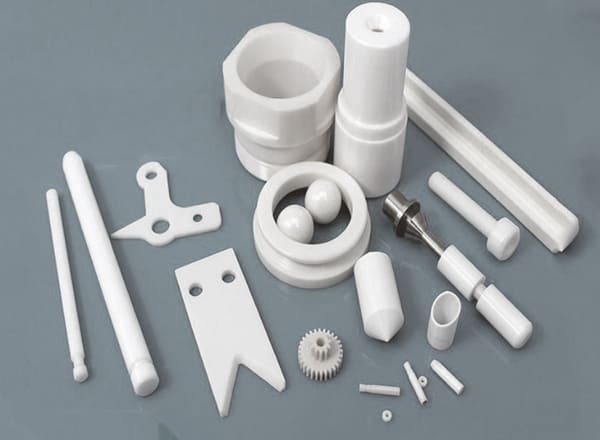
Overview of Alumina
Alumina is a ceramic material composed of aluminum and oxygen, typically existing in its most stable alpha phase (α-Al₂O₃), also known as corundum. Its key properties include:
- High Hardness: Comparable to sapphire, making it ideal for wear-resistant applications.
- Thermal Stability: Maintains structural integrity at temperatures up to 1700°C.
- Electrical Insulation: Widely used in electronic components due to its dielectric properties.
- Chemical Inertness: Resistant to corrosion in harsh chemical environments.
These attributes make alumina a versatile material, but its tensile strength, typically ranging from 200–400 MPa, is lower than its compressive strength due to its brittle nature.
Its tensile strength, which is the material’s ability to resist breaking under tension, is a key factor in determining its performance. Many variables influence alumina’s tensile strength, ranging from its crystal structure to environmental conditions. In the following, we will explore these factors in depth.
Looking for top-quality alumina ceramic products? Explore Advanced Ceramics Hub’s selection.
Factors Affecting Alumina Tensile Strength
1. Material Composition
The composition of alumina plays a pivotal role in determining its tensile strength. High-purity alumina (99.9% or higher) typically exhibits superior mechanical properties due to the absence of impurities like silica or iron oxides, which can act as stress concentrators and initiate cracks. For example, even small amounts of silica (e.g., 0.1%) can reduce tensile strength by creating weak grain boundaries.
✅ Purity Level (Al₂O₃ Content)
High-Purity Alumina (≥99.9%):
- Tensile Strength: 300–400 MPa (low impurity segregation at grain boundaries).
- Mechanism: Fewer glassy phases → stronger ionic/covalent bonds.
Low-Purity Alumina (95–99%):
- Tensile Strength: 200–300 MPa (SiO₂/CaO impurities weaken grain boundaries).
| Purity | Strength (MPa) | Best For |
| 99.9% | 400 | Aerospace, semiconductors |
| 99% | 300 | Industrial wear parts |
| 95% | 200 |
✅ Dopants & Additives
Additives or dopants are often incorporated during the manufacturing process of alumina to improve its tensile strength. For instance, sintering aids like yttria (Y₂O₃) or magnesia (MgO) can help control the grain growth of alumina, making it stronger and more stable. The use of these additives can reduce porosity and improve the overall structural integrity of the material, which can, in turn, increase its tensile strength.
- Magnesia (MgO): Promotes densification during sintering, reducing porosity and improving strength.
- Zirconia (ZrO₂): Enhances toughness through phase transformation, indirectly supporting tensile strength.
- Yttria (Y₂O₃): Stabilizes grain boundaries, preventing crack propagation.
Strength-Enhancing Dopants:
| Dopant | Effect on Tensile Strength | Mechanism |
| MgO | +15–20% (up to 460 MPa) | Inhibits abnormal grain growth |
| Y₂O₃ | +10% (at 0.5 wt%) | Forms YAG phases at grain boundaries |
| ZrO₂ | +25% (via transformation toughening) | Martensitic phase change absorbs crack energy |
However, improper additive concentrations can introduce secondary phases that compromise strength, highlighting the need for precise compositional control.
✅ Impact of Impurities
Impurities can significantly lower the tensile strength of alumina. Elements like silica (SiO₂), iron oxide (Fe₂O₃), and other foreign substances can disrupt the regularity of the alumina crystal lattice. These impurities can act as points of weakness where cracks or other forms of deformation may occur under stress. Additionally, certain impurities may react with alumina at high temperatures, leading to the formation of secondary phases that further reduce its strength.
Strength-Reducing Impurities:
- SiO₂: Forms low-melting glassy phases → −20% strength at 1 wt%.
- Na₂O: Ion migration under stress → intergranular cracking.
Discover our high-quality alumina ceramic products.
2. Crystal Structure & Microstructure
The microstructure of alumina, including grain size, porosity, and phase composition, significantly affects its tensile strength. Smaller grain sizes (e.g., 1–5 µm) generally enhance strength by reducing the likelihood of crack initiation, as smaller grains provide shorter paths for crack propagation. Conversely, coarse grains (e.g., >10 µm) can lead to stress concentrations at grain boundaries, lowering tensile strength.
Porosity is another critical factor. Voids within the material act as stress concentrators, reducing tensile strength by up to 50% in highly porous samples. Advanced sintering techniques aim to minimize porosity to achieve near-theoretical density (e.g., >99% of 3.98 g/cm³ for α-Al₂O₃). Phase composition also matters; the alpha phase is stronger than the gamma or theta phases, which may form under improper processing conditions and weaken the material.
✅ Grain Size & Distribution
The grain size and distribution of alumina also play a crucial role in determining its tensile strength. Smaller grains in alumina usually lead to higher strength, as the grain boundaries restrict the movement of dislocations, which are defects in the material’s structure that can lead to failure. This phenomenon is known as the Hall-Petch relationship, where the material becomes stronger as the grain size decreases. However, if the grains are too small, the material might become brittle, reducing its toughness.
Grain distribution can also affect the uniformity of the material. A well-distributed grain structure helps improve the tensile strength by ensuring consistent mechanical properties throughout the material.
Experimental Data:
| Grain Size (μm) | Tensile Strength (MPa) | Fracture Mode |
| 0.2 (nanocrystalline) | 550* (theoretical) | Transgranular |
| 1.0 | 400–450 | Mixed |
| 5.0 | 300 | Intergranular (80%) |
| 20 | 200 | Fully intergranular |
✅ Porosity & Defects:
| Porosity (%) | Tensile Strength (MPa) |
| 0 (HIP processed) | 400 |
| 3 | 300 |
| 5 | 240 |
| 10 | 150 |
Pore Types Matter:
- Intergranular pores are more detrimental than intragranular.
- Pore size >1 μm: Acts as a crack nucleus.
✅ Anisotropy & Texture
Hot-Pressed vs. Sintered Alumina:
| Processing | Grain Orientation | Strength Anisotropy |
| Uniaxial Hot Pressing | c-axis ⊥ pressing direction | 20% higher ⊥ to press |
| Pressureless Sintering | Random | Isotropic |
Single Crystals:
- Basal plane (0001): ~500 MPa (strongest)
- Prismatic plane (1010): ~350 MPa
Explore our optimized alumina ceramic products.
3. Processing Techniques
The methods used to process alumina directly influence its tensile strength. Sintering techniques, such as hot pressing or spark plasma sintering (SPS), affect densification and defect formation. Hot pressing at 1400–1600°C under high pressure (20–50 MPa) can achieve near-full density, minimizing voids and enhancing strength. SPS, a more advanced method, uses rapid heating and electric currents to densify alumina in minutes, reducing grain growth and improving mechanical properties.
Forming techniques, such as slip casting or injection molding, can introduce defects like microcracks or inclusions if not carefully controlled. For example, uneven drying in slip casting may create internal stresses that weaken the final product. Heat treatment conditions, including sintering temperature, holding time, and cooling rates, also play a role. Rapid cooling can induce thermal stresses, while prolonged sintering at high temperatures may lead to excessive grain growth, both reducing tensile strength.
| Processing Technique | Effect on Tensile Strength | Key Parameters |
| Hot Pressing | Enhances densification | 1400–1600°C, 20–50 MPa |
| Spark Plasma Sintering | Minimizes grain growth | 1200–1400°C, rapid heating |
| Slip Casting | Risk of defects | Controlled drying |
4. Environmental Conditions
Environmental factors significantly influence alumina’s tensile strength during use. At elevated temperatures (e.g., >1000°C), alumina may experience creep or subcritical crack growth, reducing its strength. For instance, prolonged exposure to 1200°C can decrease tensile strength by 20–30% due to thermally induced microstructural changes.
Corrosion in acidic or alkaline environments can erode grain boundaries, creating surface flaws that initiate cracks. For example, exposure to hydrofluoric acid can significantly weaken alumina. Mechanical loading conditions, such as cyclic fatigue or stress concentration around notches, also reduce tensile strength over time. These factors highlight the importance of considering operating conditions when designing alumina components.
| Environmental Factor | Effect on Tensile Strength | Mitigation Strategy |
| High Temperature | Reduces strength via creep | Use thermal barriers |
| Chemical Exposure | Erodes grain boundaries | Apply protective coatings |
| Mechanical Fatigue | Promotes crack growth | Optimize component design |
✅ Temperature Effects
A. High-Temperature Exposure
Mechanism:
- Grain boundary sliding (>1000°C) → Creep deformation.
- Phase instability: γ-Al₂O₃ → α-Al₂O₃ transition (1200°C) may induce microcracking.
| Temperature (°C) | Tensile Strength (MPa) |
| 25 (RT) | 300–400 |
| 800 | 200–250 |
| 1200 | 80–120 |
B. Thermal Cycling
Impact:
- Thermal shock resistance (ΔT critical): ~200°C for dense alumina.
- Strength loss: 10–15% after 50 cycles (25°C ↔ 800°C).
Improvement:
- ZrO₂-toughened alumina (ZTA): ΔT critical ↑ to 400°C.
✅ Oxidative & Corrosive Environments
A. Moisture/Humidity
- Hydrothermal Aging: H₂O infiltrates GBs → forms Al(OH)₃ → ↓ strength by 20% (1000h @ 85°C/85% RH).
- Worst for: High-silica alumina (SiO₂-rich GBs).
B. Acid/Alkali Exposure
| Environment | Effect (100h Exposure) | Strength Retention |
| 10% HCl | Surface pitting (50 μm depth) | 60% |
| 10% NaOH | GB dissolution | 40% |
| Molten salts | Accelerated corrosion | 30% |
✅ Mechanical Stress Corrosion
A. Static Fatigue
- Process: Slow crack growth (SCG) under sustained load + humidity.
- Solution: Polishing to remove surface flaws (↑ SCG resistance 5×).
B. Dynamic Fatigue
- Cyclic loading (e.g., bearings):
- Nf (cycles to failure) ∝ (Δσ)^–12 for alumina.
- Example: Δσ = 100 MPa → Nf ≈ 10⁶ cycles.
Request a custom quote for high-quality alumina ceramic products.
Strategies to Enhance Alumina Tensile Strength
Material Optimization
Using high-purity raw materials (>99.9% Al₂O₃) minimizes impurities that weaken the material. Tailored additives, such as magnesia or zirconia, can enhance densification and toughness, improving tensile strength. Careful control of additive concentrations ensures optimal performance without introducing deleterious phases.
| Additive | Mechanism | Optimal wt% | Strength Gain |
| MgO | Inhibits abnormal grain growth | 0.1–0.5 | +15–20% |
| Y₂O₃ | Forms YAG phases at GBs | 0.3–0.8 | +10% |
| ZrO₂ | Transformation toughening | 10–15 | +25% |
Microstructural Control
Refining grain size through controlled sintering or additives like magnesia can significantly enhance strength. Minimizing porosity via advanced sintering techniques, such as SPS, ensures a dense microstructure. Maintaining a high proportion of the alpha phase also maximizes tensile strength.
Advanced Processing
Novel sintering methods, like microwave sintering or SPS, offer faster densification with reduced grain growth. Improved forming techniques, such as additive manufacturing, allow precise control over component geometry, reducing defects. Optimizing heat treatment schedules can further minimize thermal stresses.
Environmental Protection
Applying protective coatings, such as silica or yttria-based layers, can shield alumina from chemical attack. Designing components to avoid stress concentrations and using thermal barriers in high-temperature applications can extend service life and maintain tensile strength.
At Advanced Ceramics Hub, we supply optimized-grade ceramic products that comply with ASTM and ISO standards, ensuring outstanding quality and reliability.
FAQ
| Question | Answer |
| What factors affect the tensile strength of alumina? | Factors such as crystal structure, grain size, temperature, impurities, additives, and manufacturing process impact alumina’s tensile strength. |
| How does the crystal structure affect alumina’s tensile strength? | A more crystalline structure provides higher tensile strength due to a more ordered atomic arrangement that resists deformation. |
| Does temperature affect alumina’s tensile strength? | Yes, high temperatures can weaken alumina’s tensile strength by causing thermal expansion and phase changes that create microcracks. |
| What role do impurities play in alumina’s strength? | Impurities like silica or iron oxide disrupt the crystal structure, creating weak points and reducing tensile strength. |
| How does sintering impact alumina’s tensile strength? | Proper sintering increases alumina’s density, enhancing its tensile strength by improving particle bonding. However, excessive sintering may reduce strength due to grain growth. |
| Can environmental conditions weaken alumina’s tensile strength? | Yes, exposure to moisture and chemicals can cause microcracks and surface degradation, reducing alumina’s strength over time. |
The tensile strength of alumina is influenced by a complex interplay of material composition, microstructure, processing techniques, and environmental conditions. High-purity materials, fine-grained microstructures, advanced sintering methods, and protective measures against environmental degradation are all critical for optimizing performance. As industries continue to demand high-performance ceramics, ongoing research into novel processing techniques and sustainable practices will be essential for enhancing alumina’s tensile strength while addressing production challenges. By understanding and addressing these factors, we can unlock the full potential of alumina in advanced applications.
For top-quality advanced alumina products, Advanced Ceramics Hub provides tailored solutions for various applications.
Looking for premium alumina ceramic products? Contact us today!