



Silicon Carbide Foam Filter
Silicon Carbide Foam Filter
Or email us at sales@heegermaterials.com.
Silicon Carbide Foam Filter Data Sheet
|
Reference Code: |
HM3012 |
|
Chemical Composition: |
SiC, Al2O3, SiO2 |
|
Porosity: |
80%-90% |
|
Pore Size: |
7-45 PPI |
|
Operating Temperature: |
≤1500℃ |
|
Volume Density: |
0.4-0.5 g/cm3 |
Silicon Carbide Foam Filter Description
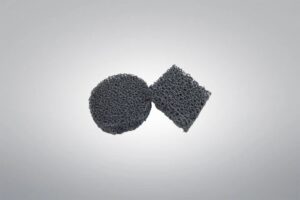
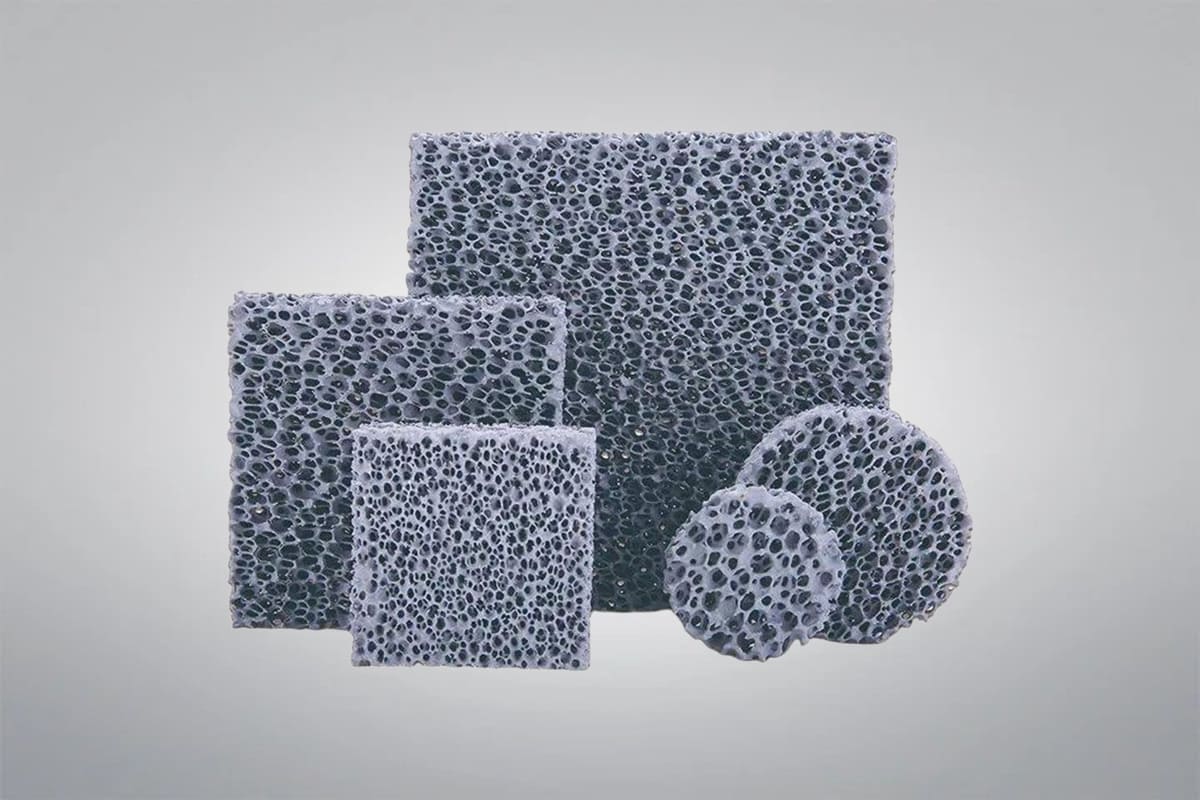
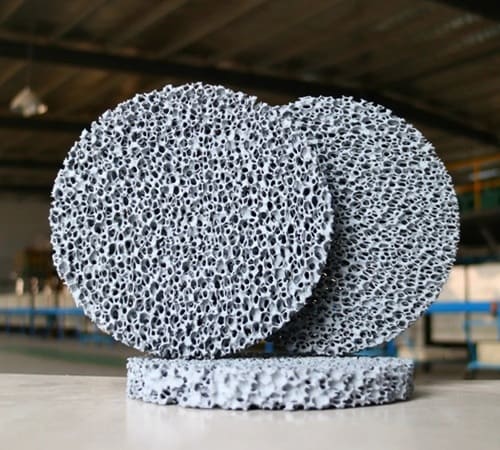
Silicon Carbide Foam Filter is an effective molten metal filter with a unique porous structure, effectively removing impurities and gases from molten metal and improving the casting quality. It offers excellent high-temperature resistance (up to 1500℃), chemical resistance, and high mechanical strength, making it ideal for filtering aluminum, copper, iron, etc. The common porosities are 10 PPI, 20 PPI, 30 PPI, and 40 PPI. Advanced Ceramics Hub supports customized solutions in sizes, thicknesses, and pore sizes for diverse industry and research applications.
 Silicon Carbide Foam Filter
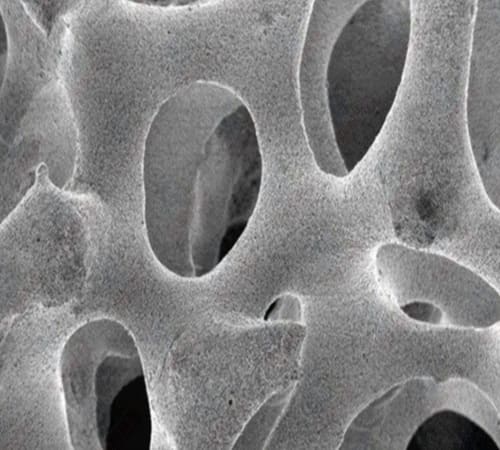
- Silicon Carbide Foam Filter Microscopic Image
Silicon Carbide Foam Filter Filtration Capacity
| Size (mm) | 10ppi | 20ppi | 30ppi | |||
| Filter Capacity (kg) | Flow Rate (Kg/s) | Filter Capacity (kg) | Flow Rate (kg/s) | Filter Capacity (kg) | Flow Rate (kg/s) | |
| Grey Iron | Grey Iron | Grey Iron | Grey Iron | Grey Iron | Grey Iron | |
| 40×40×15 | 64 | 4 | 50 | 3 | 42 | 2 |
| 40×40×22 | 64 | 4 | 50 | 3 | 42 | 2 |
| 50×30×22 | 60 | 4 | 47 | 3 | 40 | 2 |
| 50×50×15 | 100 | 6 | 78 | 3.5 | 66 | 3 |
| 50×50×22 | 100 | 6 | 78 | 3.5 | 66 | 3 |
| 60×60×15 | 144 | 9 | 112 | 6 | 95 | 5 |
| 75×50×22 | 150 | 9 | 116 | 6 | 99 | 5 |
| 75×75×22 | 220 | 14 | 175 | 10 | 149 | 8 |
| 100×50×22 | 200 | 12 | 155 | 9 | 133 | 7 |
| 100×75×22 | 300 | 18 | 232 | 13 | 199 | 11 |
| 100×100×22 | 400 | 24 | 310 | 18 | 265 | 15 |
| 150×150×22 | 900 | 54 | 698 | 40 | 596 | 33 |
| 200×200×30 | 1600 | 95 | 1240 | 58 | 1060 | 48 |
| Dia 40×22 | 40 | 3 | 39 | 2 | 33 | 2 |
| Dia 50×22 | 70 | 4.5 | 61 | 4 | 52 | 3 |
| Dia 60×22 | 100 | 6.5 | 88 | 5 | 75 | 4 |
| Dia 70×22 | 150 | 8.8 | 119 | 7 | 102 | 6 |
| Dia 75×22 | 170 | 10 | 137 | 8 | 117 | 6.5 |
| Dia 80×22 | 200 | 11 | 156 | 9 | 133 | 7 |
| Dia 90×22 | 240 | 14 | 197 | 11 | 169 | 9 |
| Dia 100×22 | 280 | 17 | 243 | 14 | 208 | 12 |
| Dia 125×22 | 400 | 24 | 380 | 22 | 325 | 18 |
| Dia 150×22 | 700 | 38 | 548 | 32 | 468 | 26 |
| Dia 200×30 | 1240 | 67 | 973 | 56 | 832 | 46 |
Silicon Carbide Foam Filter Specifications
| Dimensions (mm) | Area (mm²) | Porosity Rate (10/15ppi) | Porosity Rate (20ppi) | Porosity Rate (30ppi) | |
| Length×Width×Thickness | 40×40×11, 13, 15, 22 | 1600 | ✓ | ✓ | ✓ |
| 50×50×11, 13, 15, 22 | 2500 | ✓ | ✓ | ||
| 50×75×13, 15, 22 | 3750 | ✓ | ✓ | ||
| 50×100×15, 22 | 5000 | ✓ | ✓ | ||
| 55×55×22 | 3025 | ✓ | |||
| 60×60×22 | 3600 | ✓ | ✓ | ||
| 75×75×22 | 5625 | ✓ | ✓ | ||
| 75×100×22 | 7500 | ✓ | |||
| 100×100×22 | 10000 | ✓ | ✓ | ||
| 100×150×22 | 15000 | ✓ | ✓ | ||
| 150×150×22 | 22500 | ✓ | |||
| Diameter×Thickness | Φ 40×15 | 1526 | ✓ | ||
| Φ 40×22 | 1526 | ✓ | |||
| Φ 50×13, 15 | 1923 | ✓ | |||
| Φ 50×22 | 1923 | ✓ | |||
| Φ 60×18 | 2826 | ✓ | |||
| Φ 60×22 | 2826 | ✓ | |||
| Φ 70×22 | 3847 | ✓ | |||
| Φ 1000 ×22 | 31400 | ✓ | |||
Silicon Carbide Foam Filter Features
- High Thermal Stability: Can withstand high temperatures (up to 1500℃), making them suitable for molten metal filtration.
- High Strength: Offers excellent mechanical strength, ensuring durability during metal pouring.
- Good Filtration Efficiency: Effectively filters out impurities, improving metal quality.
- Low Pressure Drop: Ensures smooth molten metal flow while minimizing pressure loss.
- Corrosion Resistance: Resistant to corrosion from molten metals, extending filter life.
- Lightweight and Easy Handling: Despite their strength, they are lightweight and easy to handle.
- Porosity Control: Can be manufactured with controlled porosity for specific filtration needs.
Silicon Carbide Foam Filter Applications
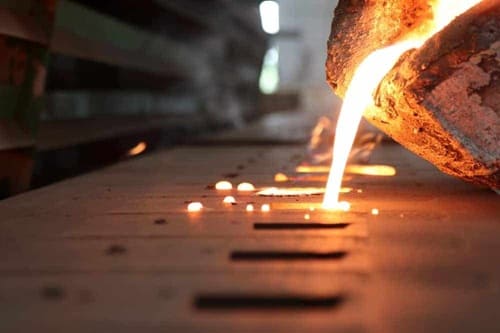
- Metallurgy: Used in foundries to filter molten metals like iron, steel, and non-ferrous alloys, improving metal purity and casting quality.
- Casting: Used to refine the quality of castings, reduce defects like porosity, and enhance surface finish.
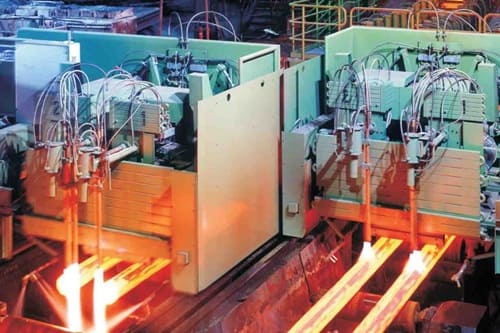
- Steel Industry: Helps in manufacturing high-quality steel by filtering molten steel before casting.
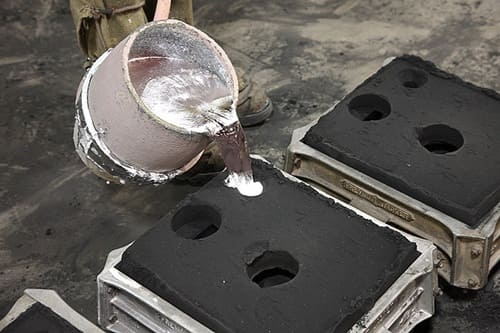
- Aluminum Casting: Widely used in aluminum and its alloys to remove impurities and improve casting integrity.
- Automotive Industry: Used in producing components such as engine blocks and other vehicles’ cast parts
 Metalurgy
- Steel industry
- Aluminum Casting
- Automobile Industry

Silicon Carbide Material Properties
Silicon Carbide Material Grades
Reaction bonded silicon carbide (RBSiC) is made by mixing SiC, carbon, and binder, then infiltrating with silicon at high temperature. The vapor-phase method reduces free silicon to under 10%, improving performance. The result is a silicon-silicon carbide composite (SiSiC), not pure SiC.
Applications:
- Low sintering temperature
- Low production cost
- High material densification
- Carbon and silicon carbide framework can be pre-machined into any shape
- Shrinkage during sintering is within 3%, aiding dimension control
- Significant reduction in the need for finishing, ideal for large, complex components
- Residual free silicon in the sintered body after processing
- Reduced strength compared to products from other processes
- Decreased wear resistance
- Free silicon is not resistant to corrosion from alkaline substances and strong acids (e.g., hydrofluoric acid)
- Limited usage due to corrosion susceptibility
- High-temperature strength is impacted by free silicon
- Typical usage temperature is limited to below 1350-1400°C
Pressureless sintered silicon carbide refers to the densification sintering of samples with varying shapes and sizes at 2000–2150°C without applying external pressure and using an inert gas atmosphere, by incorporating suitable sintering additives. The sintering process can be categorized into solid-phase sintering (SSiC) and liquid-phase sintering (LSiC).
Applications:
- High Sintering Temperature: Requires a high sintering temperature (>2000°C).
- High Purity Requirement: The raw materials must be of high purity.
- Low Fracture Toughness: The sintered body has lower fracture toughness and tends to undergo transgranular fracture.
- Clean Grain Boundaries: There is essentially no liquid phase, and the grain boundaries are relatively “clean.”
- Stable High-Temperature Strength: High-temperature strength remains stable up to 1600°C without significant changes.
- Grain Growth: At high temperatures, grain growth is easy, leading to poor grain uniformity.
- High Crack Sensitivity: The material is highly sensitive to crack strength.
- Lower Sintering Temperature: Compared to solid-state sintering, the sintering temperature is lower.
- Smaller Grain Size: The grain size is smaller, with better uniformity of grains.
- Improved Fracture Toughness: Due to the introduction of a liquid phase at the grain boundaries, the fracture mode shifts to intergranular fracture, significantly improving fracture toughness.
- Additive Influence: Uses multi-component eutectic oxides (e.g., Y2O3-Al2O3) as sintering additives, promoting densification.
- Reduced Crack Sensitivity: Liquid-phase sintering reduces the material’s sensitivity to crack strength.
- Weakened Interface Bonding: The introduction of the liquid phase weakens the bonding strength at the grain boundaries.
Pressureless sintered boron carbide combines high purity and the excellent mechanical properties of boron carbide for use in both ballistic armor and semiconductor manufacturing.
Applications:
- Enables sintering at lower temperatures and shorter times, resulting in fine grains, high relative density, and good mechanical properties.
- The simultaneous heating and pressing facilitate particle contact diffusion and mass transfer.
- Suitable for producing silicon carbide ceramics with good mechanical performance.
- The equipment and process are complex.
- High demands on mold material.
- Limited to producing simple-shaped parts.
- Low production efficiency.
- High production costs.
Recrystallized Silicon Carbide (RSiC) is a pure silicon carbide ceramic made via high-temperature evaporation-condensation, with a porous, high-strength structure, offering excellent heat, corrosion, and thermal shock resistance, used in kiln furniture, nozzles, and chemical components.
Applications:
- The sintering process, based on evaporation-condensation, doesn’t cause shrinkage, preventing deformation or cracking.
- RSiC can be shaped through methods like casting, extrusion, and pressing, and its shrinkage-free firing allows for precise dimensions.
- After firing, recrystallized RSiC contains 10%-20% residual porosity, primarily influenced by the green body’s porosity, providing a foundation for porosity control.
- The sintering mechanism creates interconnected pores, making RSiC suitable for applications in exhaust and air filtration.
- RSiC has clean grain boundaries, free from glass and metal impurities, ensuring high purity and retaining SiC’s superior properties for demanding high-performance applications.
Hot Isostatic Pressed Silicon Carbide (HIPSiC) is a high-performance ceramic produced via hot isostatic pressing. Under high temperature (around 2000 ℃) and uniform high-pressure gas (typically argon), silicon carbide powder is densified into a nearly pore-free structure.
Applications:
- Uniform mictrostructure and fine grain size
- Low sintering temperature and time
- High density
- High purity and component control
- Difficult packaging technology
- High initial investment and operational costs
- Limited for large or complex shapes
Spark Plasma Sintering Silicon Carbide is a high-performance ceramic produced using spark plasma sintering technology. This process employs pulsed current and pressure to rapidly density silicon carbide powder at relatively low temperatures (around 1800-2000 ℃) in a short time.
Applications:
- Faster heating rate
- Lower sintering temperature
- Shorter sintering time
- Fine and uniform grains
- High density
- Appliable for small and precision parts
Silicon Carbide Ceramic Machining

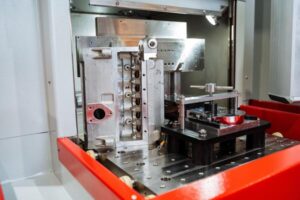
Silicon Carbide (SiC) is a highly durable ceramic material with extreme hardness (9.5 Mohs), thermal stability (up to 1650 ℃), and resistance to wear, corrosion, and high temperatures. However, machining silicon carbide presents challenges due to its extreme hardness and brittleness. Specialized techniques and tools are required to achieve precise cuts and shapes. The common machining methods include:
- Diamond Grinding: Diamond tools are used to achieve smooth surfaces and precise shapes.
- Laser Cutting: Suitable for cutting thin SiC materials. Laser cutting offers high precision and minimal material waste.
- Ultrasonic Machining: This method uses high-frequency vibrations to cut and shape brittle materials like SiC without causing cracks.
- Electrical Discharge Machining (EDM): A non-traditional method that uses electrical sparks to remove material, effective for hard ceramics like SiC.
- Grinding With CBN Tools: Cubic boron nitride (CBN) tools can be used for grinding SiC, providing an alternative to diamond grinding for certain applications.
- Water Jet Cutting: Using a high-pressure jet of water, sometimes with abrasive particles, to cut through SiC. This method is useful for cutting complex shapes.
Silicon Carbide Foam Filter Ceramic Packaging
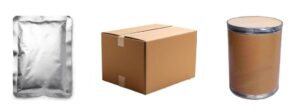
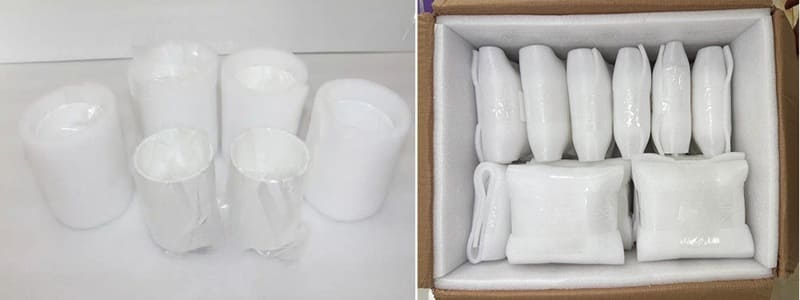
Silicon Carbide ceramic products are typically packaged in vacuum-sealed bags to prevent moisture or contamination and wrapped with foam to cushion vibrations and impacts during transport, ensuring the quality of products in their original condition.
Download
Get A Quote
We will check and get back to you in 24 hours.